Explore the synergy of seo and ppc for a balanced digital marketing strategy with this guide.
Thank you for reading this post, don't forget to subscribe!
Which is better for business: SEO or PPC?
Which one should you put your resources into?
Truth be told, the answer isn’t one or the other. You need both to succeed!
While both channels focus on increasing traffic and sales, there are key differences between the two.
If you’re not sure where to start, this article will guide you through the differences between SEO and PPC, the pros and cons of each, and how to use both channels together as part of a sound digital marketing strategy.
SEO vs. PPC: What’s The difference?
Before diving into the pros and cons of SEO and PPC, it’s important to define the two.
Defining SEO
SEO, or search engine optimization, helps your website rank in non-paid search listings. Typically, the higher rankings you receive, the more traffic you gain to your website.
Organic search results used to be referred to as the “10 blue links.” However, the search engine results page (SERP) has become more sophisticated.
Organic results can be comprised of any or a combination of the following:
- Organic listings.
- Maps.
- Knowledge panel or graphs.
- Featured Snippet.
- Images.
- Videos.
- People Also Ask box.
Here’s a modern-day example of an organic listing. Notice that the top listing has an original posting date of 2014!
![Search from search for [how to make sourdough bread], Google, October 2023](https://www.searchenginejournal.com/wp-content/uploads/2023/10/sourdough-google-organic-result-exampler-652609417126e-sej.png "SEO vs. PPC: Pros, Cons & Differences 1")
Defining PPC
PPC, or pay-per-click, focuses on targeting users with a combination of keyword and audience targeting to display paid placements on the search results page.
Like organic listings, historically, paid search ads were made up of headline and description text.
Today, PPC ads on the SERP can show much more than basic ad copy. Other elements that may be present in a search ad include:
- Sitelinks.
- Images.
- Star ratings.
- Business Profile location.
- Phone number.
- And more.
Here’s an example of a current paid search ad listing:
![Search from search for [area rugs], Google, October 2023](https://www.searchenginejournal.com/wp-content/uploads/2023/10/area-rugs-google-ads-example-652608d3d8792-sej.png "SEO vs. PPC: Pros, Cons & Differences 2")
Comparing SEO And PPC
A typical search results page has a combination of both paid ads (PPC) and organic (SEO) listings.
Besides the costs associated with SEO and PPC, there are other key differentiators between the two.
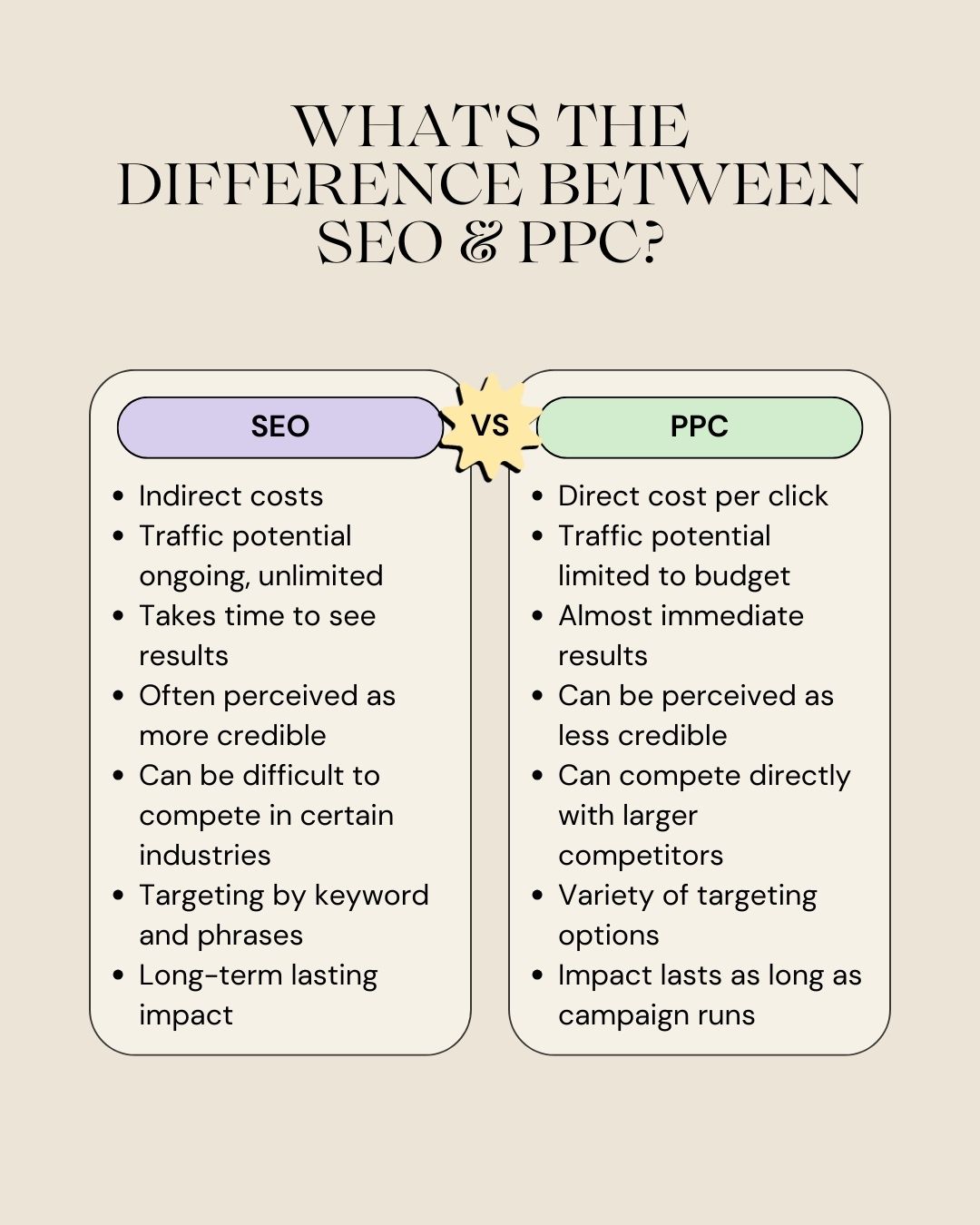
What’s The Difference Between SEO & PPC?
| SEO | PPC |
|---|---|
| Indirect costs | Direct cost per click |
| Traffic potential ongoing, unlimited | Traffic potential limited to budget |
| Takes time to see results | Almost immediate results |
| Often perceived as more credible | Can be perceived as less credible |
| Can be difficult to compete in certain industries | Can compete directly with larger competitors |
| Targeting by keywords and phrases | Variety of targeting options |
| Long-term lasting impact | Impact lasts as long as campaign runs |
SEO Pros & Cons
Investing in SEO has many business advantages but also has its downfalls.
Let’s take a look at some of the pros of SEO.
- SEO can cost less in the long term.
Technically, SEO traffic is “free,” because you’re not paying the search engines per click, unlike PPC. SEO efforts do require indirect costs, such as hiring an SEO expert or agency, optimization tools, and more. By investing in quality resources, the “cost” will pay off immensely in the long run. - SEO can provide sustainable, consistent traffic over time.
Early efforts into SEO can help drive traffic to your website, even if PPC budgets are limited – or even cut. Over time, having a well-optimized SEO strategy can help reduce the reliance on paid search and increase marketing efficiency. - SEO can increase your brand’s credibility and trustworthiness.
Sometimes, ads get a bad rap, and users are more likely to trust organic results. The higher you rank, the more you’re perceived as an authoritative source by your target audience.
Even though you can reap massive rewards through good SEO, it doesn’t come without its pitfalls.
- Requires patience to see results.
- It’s highly competitive.
- Ongoing effort to maintain results is necessary.
- Search engine algorithm updates can impact website visibility.
- Quality content can be tricky – especially for small businesses.
- Organic visibility can be impacted by ad dominance on the SERP.
Defining key goals and measurement protocols from the start makes it easier to determine if your SEO efforts are paying off or if pivots are necessary.
PPC Pros & Cons
Before deciding to invest in PPC, make sure to weigh the advantages and disadvantages.
Here are some of the key pros of PPC:
- PPC is highly targeted, allowing you to reach the right audience.
There’s a variety of ways to target ads, including keyword, demographic, lifestyle, contextual, placement, and more. Narrowing your reach helps ensure your PPC budget is driving the most relevant traffic to your website – and, ultimately, better customers. - PPC can show immediate results. Setting up your first PPC campaign can take as little as a few hours. Unlike organic traffic, which takes time to prove its efficiency, PPC ads can start serving almost immediately after a campaign launch. PPC is a great way to increase website traffic and sales in a short window of time.
- PPC is easier to test and experiment with. Not only can PPC show results quickly, but it’s also faster to scale and optimize. A/B testing can be performed at scale and usually within the ads platform like Google Ads. The faster data is gathered, the faster it can be analyzed, tested, and optimized for better results.
Like all other channels, PPC has its downfalls.
- It can become extremely expensive.
- Ads are sometimes perceived as less credible.
- Traffic stops as soon as the budget is gone.
- Ad efficiency can decrease.
- Keyword targeting has loosened in recent years.
You should have a better idea of the pros and cons of both SEO and PPC.
Now it’s time to answer the burning question: SEO or PPC?